


 首页
首页Biochar,Volume 7, article number 81, (2025)
ABSTRACT
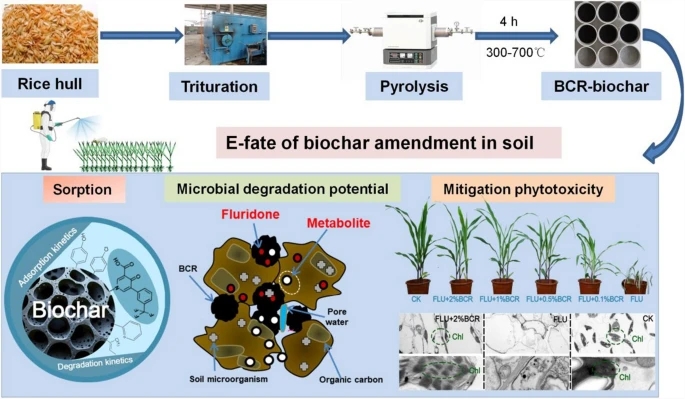
Owing to wide application and persistence, fluridone has demonstrated side-effects on non-target plants and aquatic organisms. This study investigated the potential of biochar as remediation in soil using rice hull biochar (BCR) produced at different temperatures and in four types of soil. The results indicated that, with increasing pyrolytic temperature from 300 to 700 ºC, biochar properties changed, for example, specific surface area values increased from 38.21 to 126.12 m2 g−1. Sorption affinity (Kf) of BCR ranged from 409 to 1352 and 1301 to 6666 (μg/g)/(mg/L)n for fluridone and its metabolite fluridone acid respectively. After amendment with 2% BCR500, fluridone and fluridone acid could easily be adsorbed in different types of soils, and Kf values were 1.30–3.73 times higher than those in pure soil. Half-lives values varied between different soils and fluridone acid (179–306 days) persisted significantly longer than fluridone (39–179 days) in soil. After amendment with 2% BCR500, fluridone and fluridone acid were degraded faster. Experiments under sterilized conditions demonstrated biodegradation to be the dominant process in unamended (61.59%–64.70%) and amended (67.71%–77.67%) soil. Bioinformatic analysis showed that fluridone reduced the diversity of the soil microbial community, but the abundance of microorganisms with degradation function increased and these became dominant species after BCR was added, particularly with higher numbers of degrading bacteria like Lysobacter, Pseudonocardia and Sphingomonas. Co-occurrences also revealed that BCR tightened bacterial connection and relieved fluridone stress. This work helps us better understand these processes and optimize the application of biochar for reducing pesticide contamination in agricultural soils.
Graphical Abstract
Biochar,IF=14.1
https://link.springer.com/article/10.1007/s42773-025-00469-9