


 首页
首页https://doi.org/10.1016/j.foodres.2025.117446. Food Research International,2025
Abstract
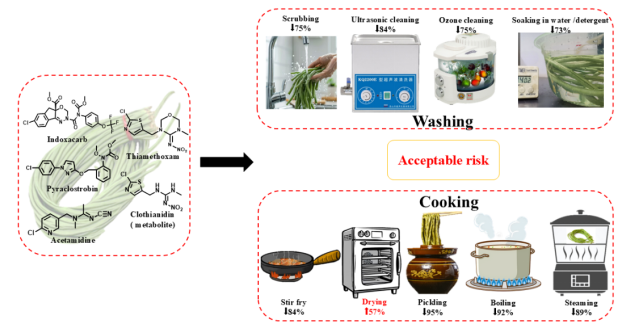
Consumption is the primary exposure route to pesticide residues. However, systematic quantification of how household processing method reduce dietary exposure based on pesticide chemical properties remain limited, hindering refined risk assessment. This study addressed this gap by providing the first systemic evaluation of ten common household processing methods (washing, ultrasonication, cooking, drying, pickling) for effectively removing five typical commonly used pesticides (pyraclostrobin, indoxacarb, acetamiprid, thiamethoxam, and clothianidin) with distinct physicochemical properties in cowpeas. Data indicated that washing cowpeas significantly reduces pesticide residues, with processing factors (PF) for the above five pesticides ranging from 0.22 to 0.54, 0.20 to 0.59, 0.18 to 0.67, 0.36 to 0.86, and 0.16 to 0.97, respectively. PFs for steaming, boiling, stir-frying, and pickling were less than 1. Notably, boiling for 10 min achieved the highest reduction (83–92%), whereas drying paradoxically increased residue concentrations (PFs up to 1.57). This study revealed that pesticide behavior during processing was influenced by LogKow. By integrating PF into risk assessment, the national estimated daily intake (NEDI) for all pesticides remained below 24.98% of the ADI, confirming low long-term dietary risks. This study provides actionable guidelines for optimizing household practices and provides an accurate dietary risk assessment for processed cowpea products.
Graphical abstract
Food Research International,IF=8.5
https://www.sciencedirect.com/science/article/pii/S0963996925017843