


 首页
首页https://doi.org/10.1016/j.envint.2025.109491,Environment International, 2025
Abstract
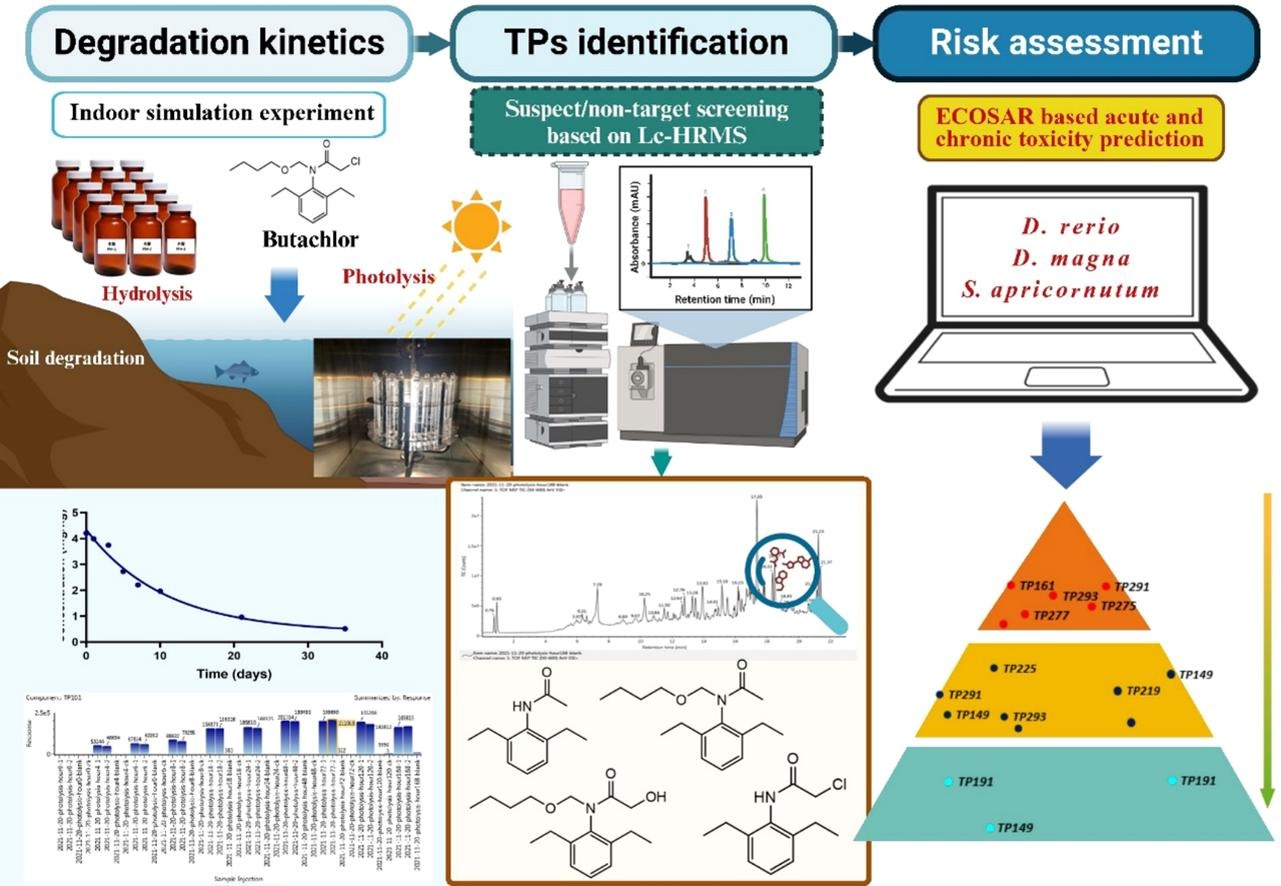
Butachlor (BTR), a widely used chloroacetanilide herbicide in rice paddies worldwide, has raised concerns due to limited data on its environmental transformation products (TPs) and their ecotoxicological effects. This study systematically investigates BTR’s degradation kinetics, mechanisms, pathways, and ecotoxicity in water and soil through batch tests, integrating Non-Target Screening (NTS) with Quantitative structure–activity relationship (QSAR) modeling. Hydrolysis half-lives (DT50) ranged from 73.2 to 196 days (pH 4–9), while photolysis half-lives were 12.9–18.6 h, indicating enhanced degradation in alkaline and light-exposed conditions. In three representative soils, DT50 values ranged from 22.3 to 38 days, with black soil exhibiting the most rapid degradation. Moreover, anaerobic conditions marginally accelerated degradation in both fluvo-aquic and red soils. Using UPLC-Q-TOF-MS, ten TPs were identified, including three novel ones, and four (TP191, TP225, TP277, TP293) were confirmed with synthetic standards. A probable transformation mechanism was suggested based on the identified TPs and Density Functional Theory (DFT) based calculations. Mechanistically, BTR degradation in soil primarily involves N-demethylation, N-debutoxylation and hydrolysis, whereas in water it proceeds through a more diverse array of pathways – including dechlorination, hydroxylation, dehydrogenation, N-debutoxylation, cyclization, hydrolysis, dehydration, and oxidation. Finally, Ecotoxicity modeling showed certain TPs, particularly TP277, had “extreme” acute toxicity to Daphnia magna, while TP277 and TP293 posed higher chronic toxicity risks to Danio rerio than the parent compound. These findings highlight the ecological risks of BTR TPs and advocate for their inclusion in environmental risk assessments to safeguard aquatic ecosystems.
Graphical abstract
Environment International, IF=10.3
https://doi.org/10.1016/j.envint.2025.109491